
Aoraki Mount Cook Landscape Photography – A Photographer’s Guide
By Richard Hume | New Zealand Landscape Photographer
Aoraki Mount Cook National Park is one of New Zealand’s great destinations for landscape photography. Dominated by the Southern Alps and Aoraki/Mount Cook, the park offers an extraordinary variety of photographic opportunities, from the mountains, rivers and alpine landscapes of the Hooker and Tasman Valleys to glacial lakes, icebergs and some of the most dramatic light in the country.
I have photographed this area many times over the years returning time and again to photograph this vast landscape. In this guide I’ll share some of the locations I enjoy photographing, the times and conditions I find work best, and some practical advice for getting the most from photographing this remarkable part of New Zealand.
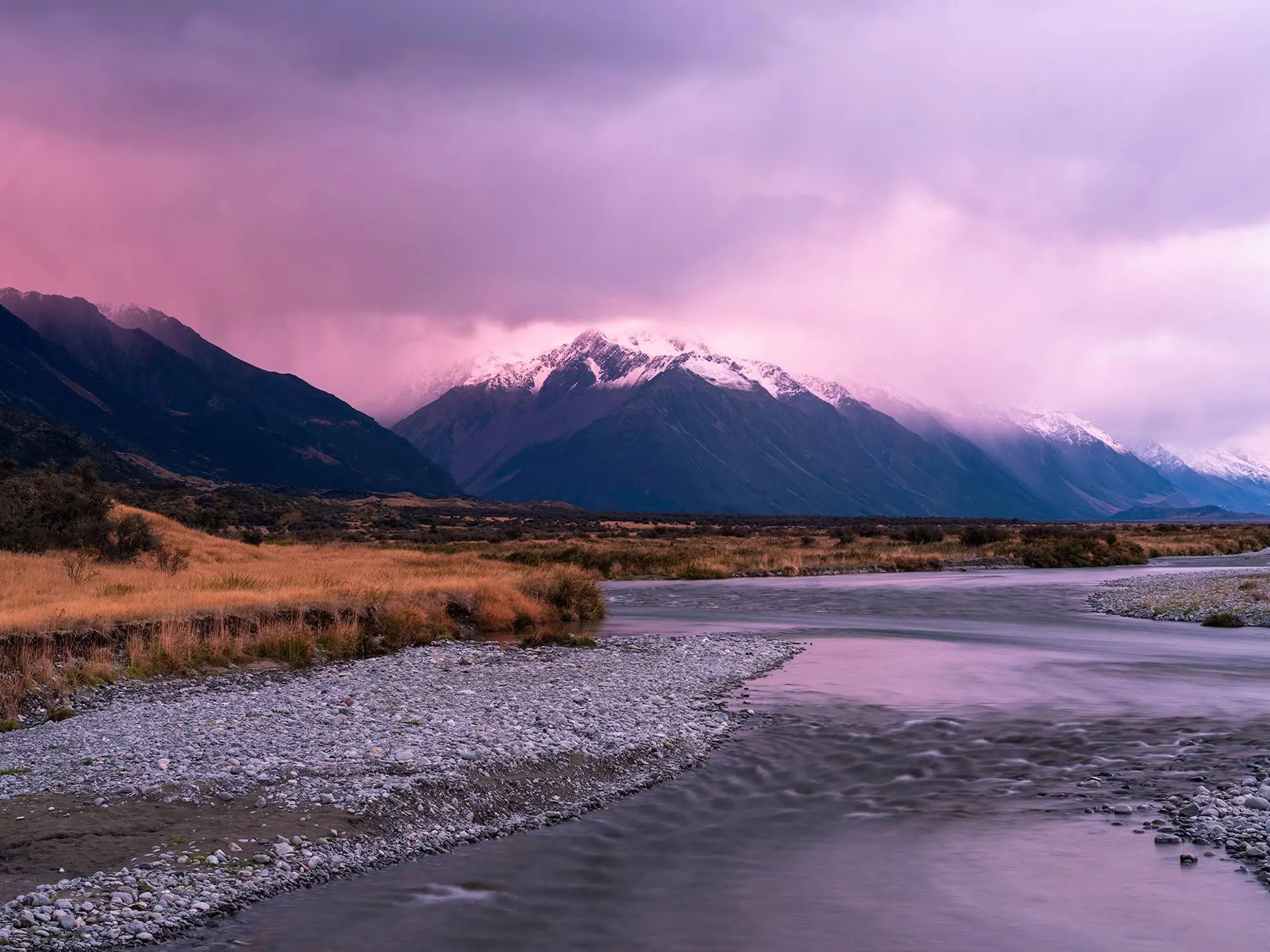
Landscape Photography in the Hooker Valley
The Hooker Valley is one of my favourite areas to photograph in Aoraki/Mount Cook National Park. What makes it particularly rewarding is the variety of landscapes you encounter along a relatively short and accessible track. From Mueller Lake and the imposing slopes of Mount Sefton near the beginning, the landscape gradually opens up as you move further into the valley, eventually reaching Hooker Lake beneath Aoraki/Mount Cook.
Mueller Lake and Mount Sefton
One of the first photographic opportunities on the Hooker Valley Track is the view across Mueller Lake towards Mount Sefton. The combination of the glacial lake, steep mountain faces and the scale of the surrounding landscape makes this a particularly impressive introduction to the Hooker Valley.
I particularly like the view from around the first suspension bridge, where a wide-angle lens allows you to bring together Mueller Lake, Mount Sefton and the wider mountain landscape. The scale of the scenery here really suits a wider composition, and it is worth taking some time to explore the different viewpoints. If you are here at dusk to capture colour in the clouds above Mt Sefton, then it is a short walk back to the car park in the dark.
Photographing Along the Hooker Valley Track
As you continue further into the Hooker Valley, there are some fantastic photographic opportunities, which is one of the things I particularly enjoy about photographing here. The landscape is very open, but there is plenty to work with in the foreground, including the Hooker River, alpine tussock, sections of boardwalk and a small tarn that can provide beautiful reflections when conditions are calm.
It is worth allowing plenty of time and looking beyond the obvious views of Aoraki/Mount Cook. I often use a mid-range lens for compositions along the track, particularly where the boardwalk or other foreground elements can be used to lead the eye into the wider mountain landscape. At other times, a wide-angle lens works particularly well when you want to convey the scale and openness of the valley.
I wouldn’t try to photograph everything on a single visit. The Hooker Valley is a big mountain landscape and the light and weather can change considerably throughout the day. If time allows, photographing it on more than one occasion – perhaps early in the morning and again later in the afternoon – gives you a better chance to explore the valley and capture strong compositions.
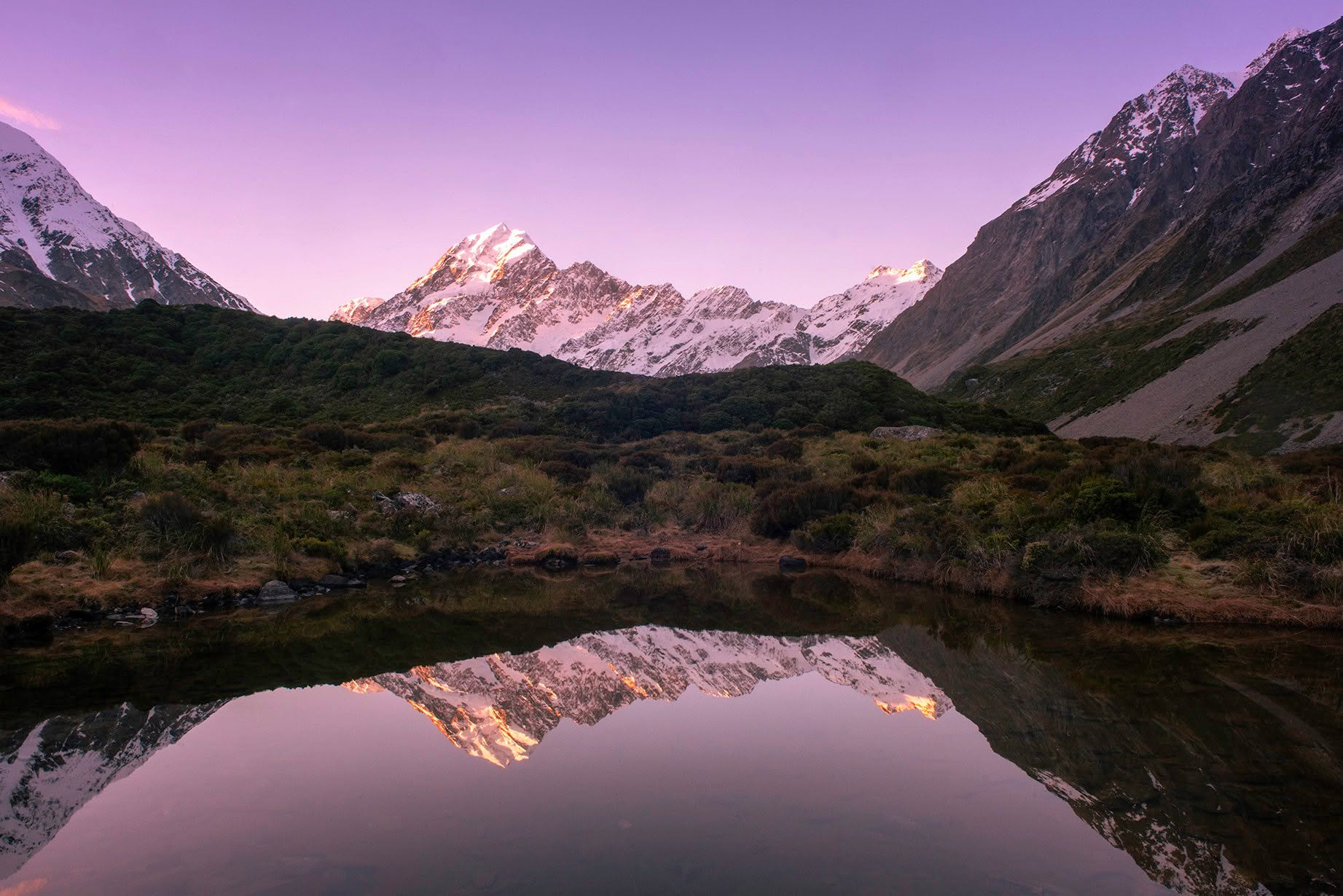
Photographing Hooker Lake
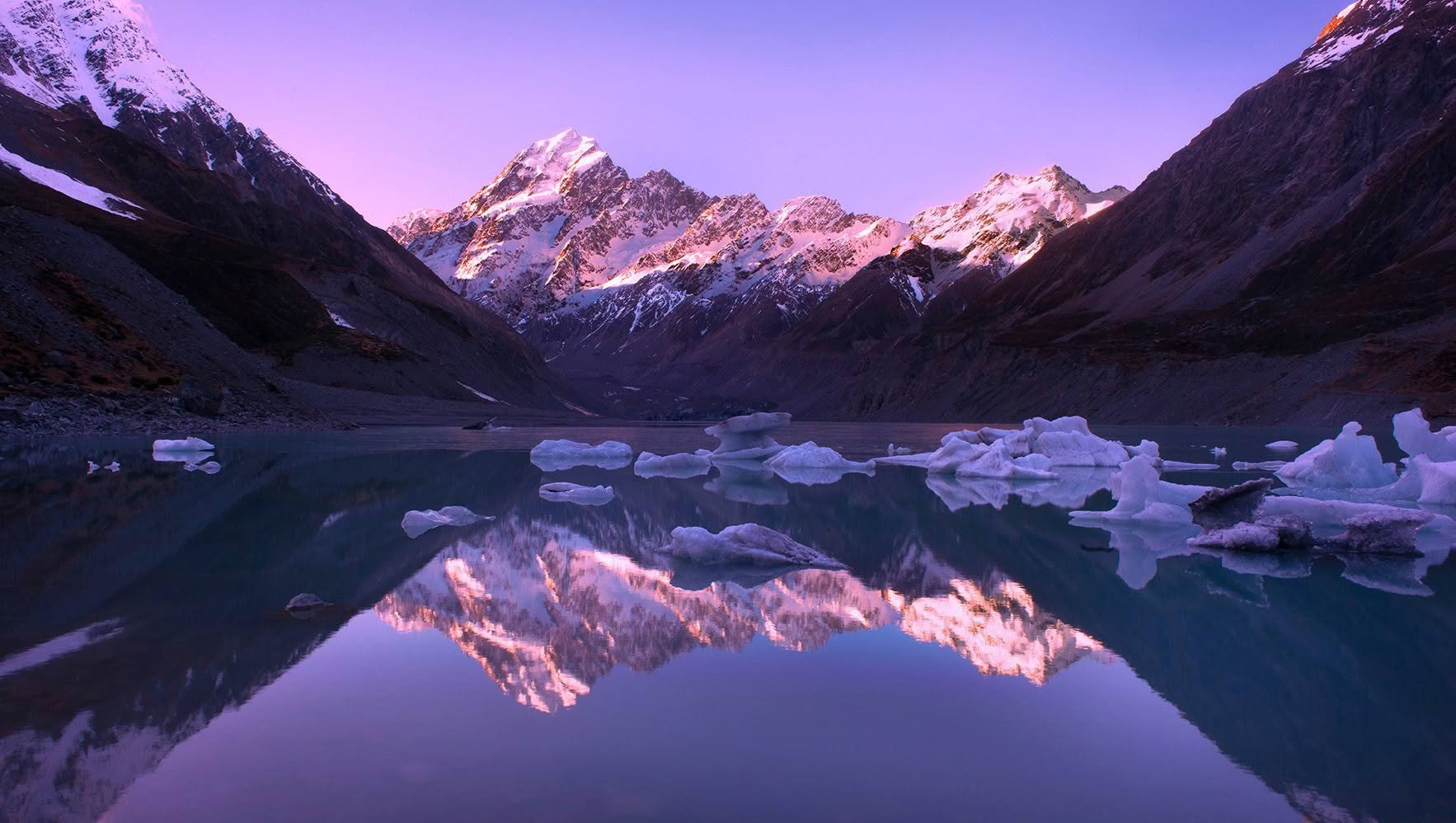
Hooker Lake is one of my favourite locations to photograph in the national park. Sitting beneath Aoraki/Mount Cook at the head of the valley, it is a scene that can be quite different each time you visit. Icebergs regularly break away from the Hooker Glacier and drift across the lake, sometimes reaching the shoreline and providing wonderful foreground elements for photographs.
I generally favour a wide-angle lens here. When icebergs are present close to the shore, they can be incorporated prominently into the foreground while still retaining Aoraki and the surrounding mountain range in the background. I find the strongest compositions often come from bringing these different elements of the landscape together.
I usually aim to photograph Hooker Lake later in the day and towards dusk. The last light on Aoraki and the surrounding peaks can transform the scene, while broken or stormy cloud often adds atmosphere. It is a location where conditions can change quickly, so I prefer to give myself plenty of time rather than arriving for a single predetermined photograph. Be prepared however for a long walk back to the car park in the dark.
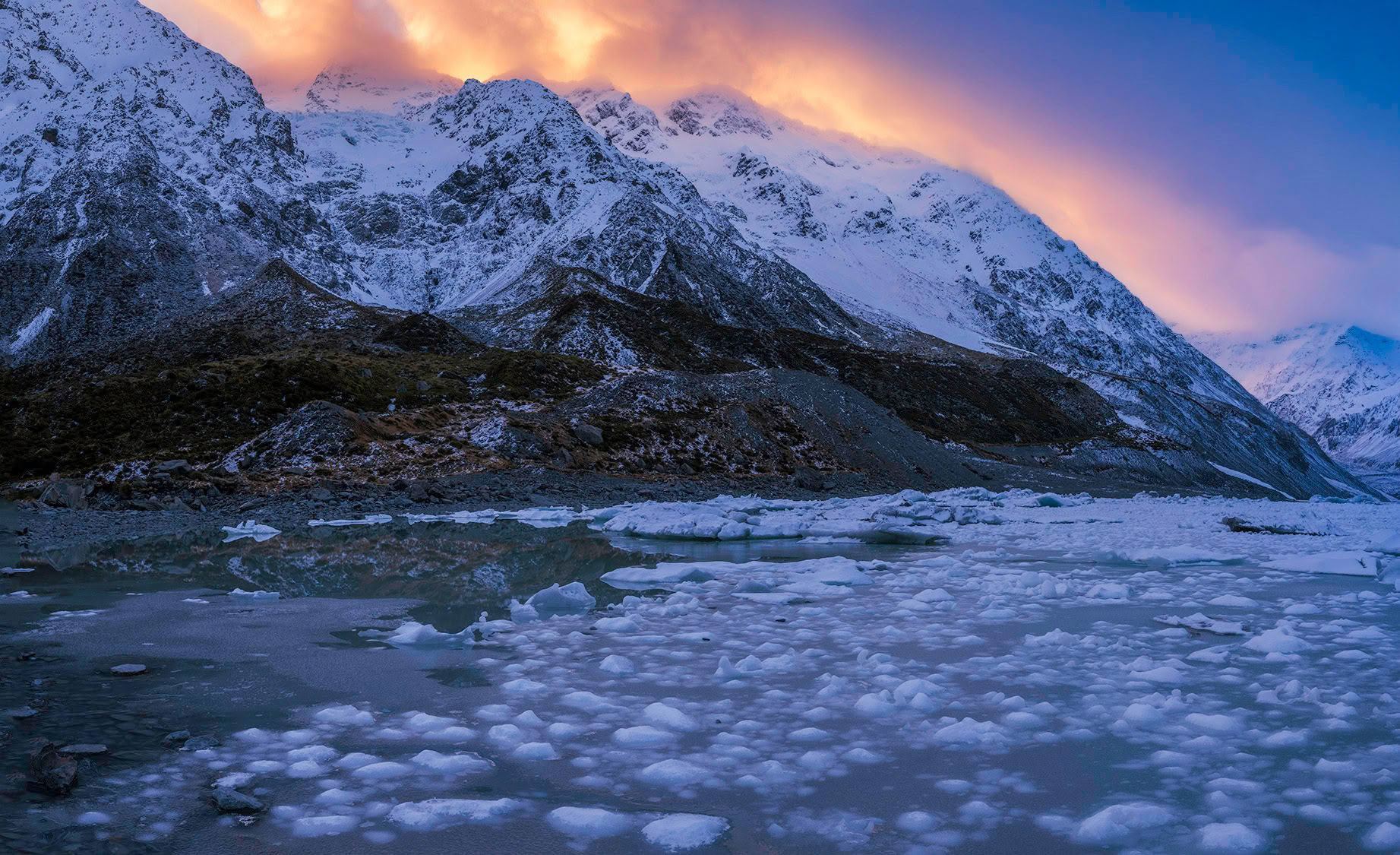
The Best Time to Photograph the Hooker Valley
For landscape photography, I generally favor the beginning and end of the day in the Hooker Valley. Early morning can provide beautiful light and quieter conditions, while later afternoon through to sunset is my preferred time for exploring the valley and photographing Hooker Lake.
Some of the most interesting conditions occur when there is broken or stormy cloud around the mountains, allowing light to move across the landscape and creating more atmosphere.
Time is particularly important here. When photographing the Hooker Valley I will often allow the entire afternoon, continuing through sunset and walking back after dark. If you plan to do this, you need to be properly prepared with a headlamp or torch and suitable clothing. For photographers, the normal walking time for the track doesn’t really reflect how long you may want to spend here, as you will be stopping regularly and potentially waiting for the right conditions.
If your schedule allows, I would also recommend visiting the valley more than once. An early morning and a late-afternoon visit can produce quite different conditions. Rather than trying to photograph every viewpoint on one walk, take your time, watch what the light is doing and concentrate on the strongest opportunities you find.
Landscape Photography at Tasman Lake
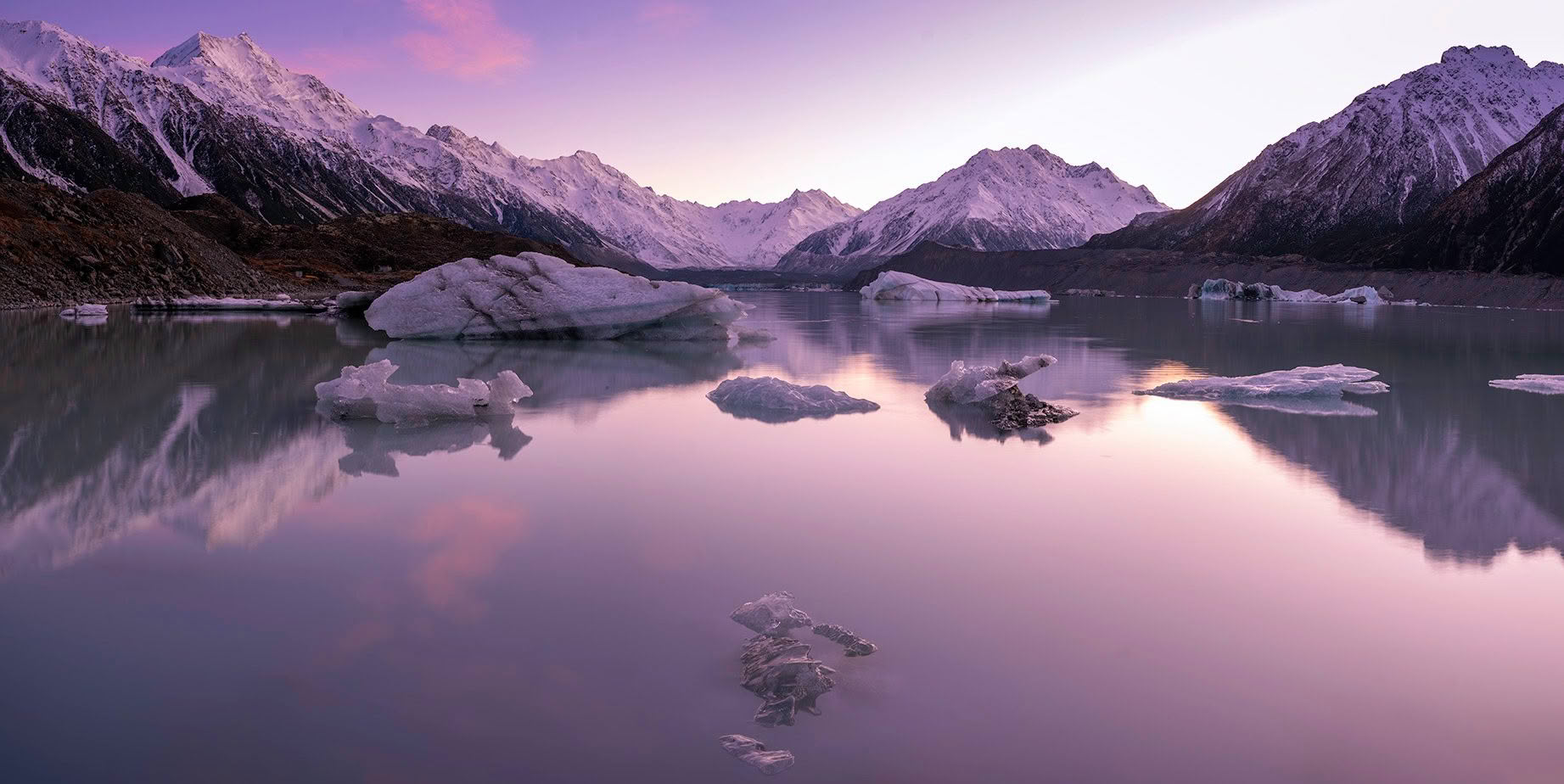
Tasman Lake is one of my favorite locations for dawn photography in Aoraki/Mount Cook National Park. I prefer photographing from around lake level, where the lake itself becomes an important part of the composition and the first light of the morning begins to appear behind the surrounding mountain ranges. The landscape here can feel quite stark and dramatic, particularly in the softer light around dawn, and conditions can change considerably from one visit to the next.
One of the elements that makes Tasman Lake particularly interesting photographically is the presence of icebergs that have broken away from the Tasman Glacier. They can drift down the lake and sometimes collect close to the shoreline, providing different foregrounds each time you visit. For me, this unpredictability is part of what makes the location so special – you can return to exactly the same area but never be presented with quite the same landscape twice.
Landscape Photography in the Tasman Valley
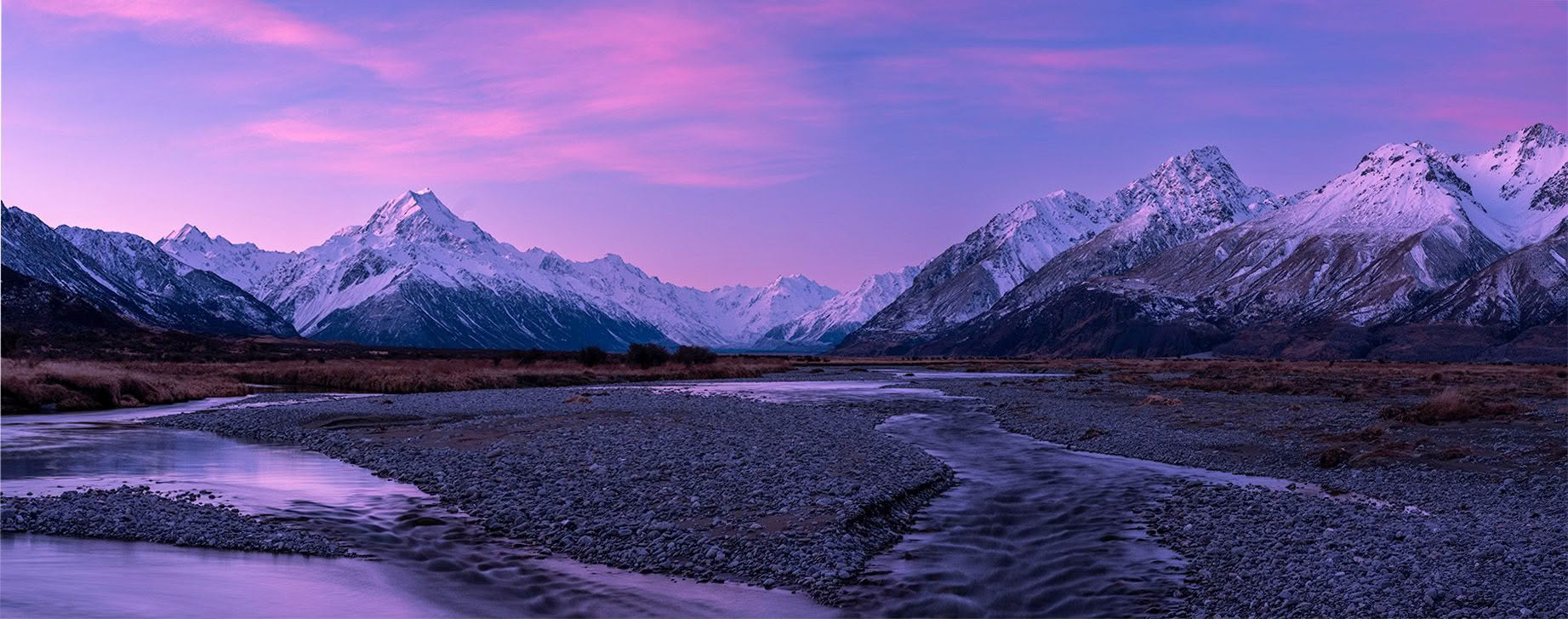
The Tasman Valley offers a very different landscape photography experience from the Hooker Valley. Rather than having the mountains immediately in front of you, the landscape feels wider, more open and, in places, quite wild. Some of my favourite compositions here use the Tasman River and tussock in the foreground with the mountains stretching across the background, creating scenes that work particularly well as wider or panoramic images.
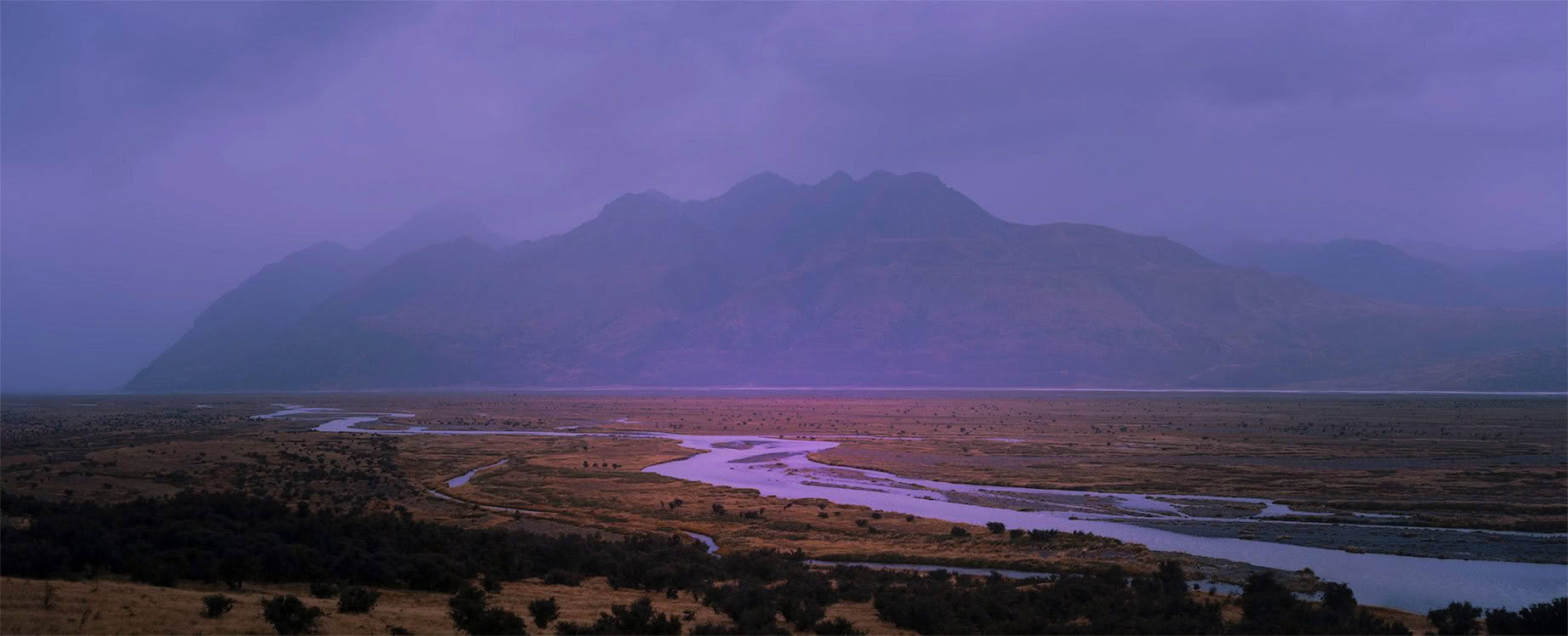
I especially enjoy photographing the valley around dusk, when the last light can filter through the mountains and completely change the landscape. Aoraki/Mount Cook doesn’t necessarily need to be visible either — some of the best conditions I have photographed here have occurred when the mountain was hidden by cloud but beautiful light was developing elsewhere across the valley.
Other Photography Locations in Aoraki/Mount Cook National Park
There are several other established photography and walking locations within the national park, including Sealy Tarns, Red Tarns and Kea Point. These locations provide further opportunities to explore the park and photograph the surrounding mountain landscape.
Sealy Tarns
Sealy Tarns offers a very different perspective on Aoraki/Mount Cook National Park, with the climb providing increasingly elevated views across the Hooker Valley, Mueller Lake and towards Aoraki/Mount Cook. The track is considerably more demanding than the Hooker Valley Track, but the higher viewpoint opens up opportunities for wider mountain landscapes and layered compositions across the valley. For photographers prepared for the climb, it provides a perspective that is quite different from photographing at valley level.
Red Tarns
Red Tarns is another elevated option close to Aoraki/Mount Cook Village. The track climbs above the village to the tarns and viewpoints overlooking the Hooker Valley and surrounding mountains. It can be a useful alternative for photographers wanting an elevated perspective without committing to the longer climb towards Sealy Tarns.
The Best Time of Year to Photograph Aoraki/Mount Cook
There is no single best time of year to photograph Aoraki/Mount Cook. The Southern Alps are a highly seasonal environment, and the character of the landscape changes considerably throughout the year. For me, the conditions are more important than choosing a particular month — interesting light, fresh snow, cloud around the mountains or a clearing weather system can transform a familiar location at almost any time of year.
Autumn and winter are particularly rewarding. Cooler temperatures can bring fresh snow lower onto the surrounding mountains, while shorter days make photographing both dawn and dusk considerably more manageable. Winter can produce some spectacular alpine conditions, although you need to be prepared for cold temperatures, ice and rapidly changing weather. Spring can also be dramatic, with plenty of snow remaining on the higher mountains and increasingly changeable conditions as the season progresses.
Summer brings long days and generally easier access, but it isn’t necessarily my preferred season photographically. The stronger midday light and completely clear days can make the landscape harder to work with, although early morning and late evening can still be excellent. Whatever the season, I would avoid planning a visit around the expectation of particular conditions. Aoraki/Mount Cook creates its own weather, and being flexible enough to respond to what you are given is an important part of photographing here.
Weather and Light in Aoraki/Mount Cook National Park
Weather is one of the biggest influences on landscape photography in Aoraki/Mount Cook National Park, and conditions can change remarkably quickly. While a clear view of Aoraki is always impressive, I don’t necessarily regard completely clear skies as the ideal photographic conditions. Broken cloud, an approaching or clearing weather system and light filtering through gaps in the mountains can create far more interesting photographs.
It is also important not to become too focused on whether Aoraki itself is visible. I have photographed some of my favourite conditions in the Tasman Valley when Aoraki was completely covered by cloud, but beautiful light was developing across the river, tussock and surrounding mountains. In an environment like this, it pays to keep looking around you and respond to what the weather and light are actually doing rather than waiting for one predetermined photograph.
Some of the most rewarding light can occur around the edges of the day or as weather moves through the Southern Alps. Conditions that initially appear unpromising can change very quickly, particularly towards dusk. For that reason, I generally prefer to allow plenty of time at a location and see how the conditions develop rather than leaving simply because the mountain has disappeared behind cloud.
Camera Equipment for Photographing Aoraki/Mount Cook
I generally carry three lenses when photographing around Aoraki/Mount Cook: a wide-angle, a mid-range zoom and a longer lens. On my Fujifilm GFX system these are the 20–35mm, 32–64mm and 45–100mm lenses. This gives me plenty of flexibility, from very wide compositions that capture the scale of the valleys and mountains through to tighter compositions and panoramic images.
I probably use the wide-angle and mid-range focal lengths most often. A wide-angle lens is particularly useful in locations such as Hooker Lake, where foreground icebergs can be combined with the mountains behind, or around Mueller Lake and Mount Sefton where I want to convey the scale of the wider landscape. A mid-range lens is useful for more controlled compositions along the Hooker Valley Track, including boardwalks and other foreground elements, while a longer focal length can work particularly well for panoramic compositions in the Tasman Valley.
A solid tripod is an essential part of my landscape photography equipment, particularly when working around dawn and dusk or using longer exposures. I also carry a polarising filter and neutral density filters. You certainly don’t need exactly the same equipment I use, but having a range of focal lengths gives you considerably more freedom to respond to the landscape rather than approaching every location with the same type of composition.
Practical Advice for Landscape Photographers
One of the most important things I would recommend when photographing Aoraki/Mount Cook is to allow plenty of time. Distances that seem relatively short on a walking guide can take considerably longer when you are regularly stopping to explore compositions, set up a tripod or wait for the light to change. When I photograph the Hooker Valley, for example, I will often allow the entire afternoon and continue photographing through sunset rather than trying to complete the track within a particular time.
If possible, don’t try to photograph everything in a single visit. Returning to a location at a different time of day or in different weather can completely change what you find. I would rather concentrate on a few strong photographic opportunities than rush from viewpoint to viewpoint trying to capture everything. If you intend to photograph around dawn or dusk, be prepared for colder temperatures and, where necessary, walking in darkness with a headlamp or torch.
Before heading out, it is also worth checking the Department of Conservation website for current track conditions, alerts and any temporary closures within Aoraki/Mount Cook National Park.
Finally, stay flexible. Mountain weather doesn’t always provide the conditions you were hoping for, but that doesn’t mean there isn’t a photograph to be made. Look beyond the obvious views of Aoraki, watch how light is interacting with the surrounding mountains, rivers, lakes and cloud, and be prepared to change your plans as conditions develop.
Frequently Asked Questions About Photographing Aoraki/Mount Cook
Some of the best landscape photography locations around Aoraki/Mount Cook include the Hooker Valley, Hooker Lake, Mueller Lake and Mount Sefton, Tasman Lake and the wider Tasman Valley. Each offers something different, from close mountain views and glacial lakes to rivers, tussock and wider panoramic landscapes. I particularly enjoy the Hooker Valley for its variety and Tasman Lake for dawn photography.
There is no single best time of year to photograph Aoraki/Mount Cook, as every season offers different conditions. Autumn and winter can bring fresh snow and shorter days, while spring often combines snow on the mountains with changeable weather. Summer provides long days and easier conditions, although the stronger light and clear skies can sometimes be less interesting for landscape photography.
Both sunrise and sunset can produce excellent photography around Aoraki/Mount Cook, and the best choice depends on the location and conditions. I particularly like Tasman Lake around dawn, while the Hooker Valley and Tasman Valley can be very rewarding later in the day and around dusk. More important than choosing sunrise or sunset is watching the weather and being ready to respond when interesting light develops.
Yes. The Hooker Valley Track is one of the best locations for landscape photography in Aoraki/Mount Cook National Park because it offers a remarkable variety of subjects along a relatively accessible route. Photographic opportunities include Mueller Lake, Mount Sefton, the Hooker River, alpine tussock, reflections, mountain views and Hooker Lake beneath Aoraki/Mount Cook.
A wide-angle to mid-range lens will cover many of the landscape photography opportunities around Aoraki/Mount Cook, although a longer lens is also useful. I use wide-angle lenses for expansive landscapes and strong foregrounds, such as icebergs at Hooker Lake, mid-range focal lengths for more controlled compositions, and longer focal lengths for tighter mountain views and panoramic compositions.
Photographers should allow considerably more time for the Hooker Valley Track than someone completing it purely as a walk. I will often allow an entire afternoon, photograph through sunset and then walk back after dark. Allowing extra time means you can explore compositions, wait for changing light and concentrate on a few strong photographs rather than rushing from one viewpoint to another. If returning after dark, make sure you are properly prepared with a headlamp or torch and appropriate clothing.
Photographing Aoraki/Mount Cook
Aoraki/Mount Cook National Park is a place I continue to return to as a landscape photographer. The combination of mountains, glaciers, rivers and alpine lakes provides an extraordinary variety of subjects, but it is the constantly changing light and weather that makes photographing this landscape particularly rewarding.
My advice is to allow yourself plenty of time and avoid approaching the area with a fixed list of photographs you need to capture. Explore the landscape, return to locations when you can, and be prepared to change your plans as the conditions develop. Some of the most memorable photographs can come from those occasions when the weather and light provide something completely different from what you originally expected.
I also visit Aoraki/Mount Cook as part of my New Zealand landscape photography tours, where small groups allow us the flexibility to work around the light, weather and photographic opportunities we encounter. If you would like to explore and photograph landscapes such as these with me, you can find details of my upcoming New Zealand Photography Tours here.